

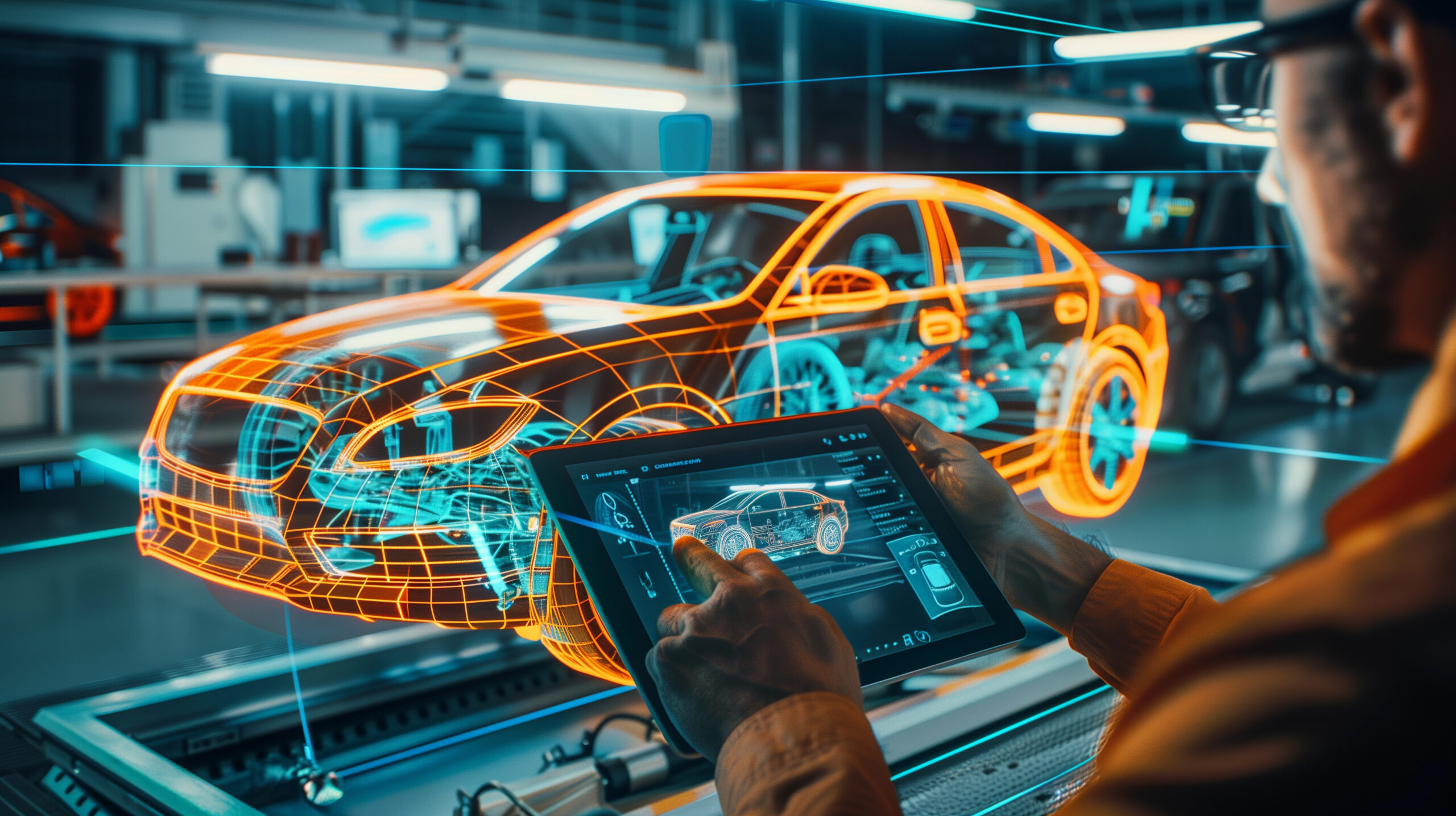
Artificial intelligence is redefining the automotive industry from the factory floor to the driver’s seat. What was once limited to mechanical engineering now depends heavily on data, algorithms, and intelligent systems. AI is improving safety, efficiency, sustainability, and customer experience, making vehicles smarter and more responsive than ever before.
AI in Automotive Manufacturing
Manufacturing is one of the earliest areas where AI delivered measurable impact. Intelligent systems now support faster production with higher accuracy.
Key applications include:
- Predictive maintenance for factory equipment
- Computer vision for defect detection
- Robotics that adapt to real-time production needs
- Optimized supply chain and inventory planning
These capabilities reduce downtime, lower costs, and improve overall product quality.
Autonomous and Driver-Assistance Technologies
AI is the foundation of modern driver-assistance systems and autonomous driving research. Vehicles rely on machine learning models to interpret data from cameras, sensors, and radar.
AI enables features such as:
- Lane departure warnings and lane centering
- Adaptive cruise control
- Automatic emergency braking
- Pedestrian and obstacle detection
While full autonomy is still evolving, AI-powered assistance already enhances road safety and driving confidence.
Predictive Maintenance and Vehicle Diagnostics
AI-driven diagnostics allow vehicles to monitor their own health continuously. By analyzing sensor data and driving patterns, AI can identify issues before they lead to breakdowns.
Benefits include:
- Reduced repair costs
- Fewer unexpected failures
- Extended vehicle lifespan
- Improved fleet reliability
This proactive approach replaces traditional reactive maintenance.
Smarter In-Car Experiences
Modern vehicles are becoming intelligent digital environments. AI personalizes the driving experience by learning user behavior and preferences.
Examples include:
- Voice-controlled assistants
- Adaptive infotainment recommendations
- Personalized climate and seating adjustments
- Driver attention and fatigue monitoring
These features improve comfort while minimizing distractions.
AI and Connected Vehicle Ecosystems
Connected vehicles generate and exchange vast amounts of data. AI processes this information to support smarter mobility systems.
Connected AI capabilities include:
- Real-time traffic prediction
- Dynamic route optimization
- Vehicle-to-vehicle communication insights
- Improved navigation accuracy
This connectivity enables smoother traffic flow and more efficient transportation networks.
AI in Electric and Sustainable Mobility
AI plays a critical role in the growth of electric and sustainable vehicles. Intelligent systems help manage energy consumption and battery performance.
Key contributions include:
- Optimized battery charging and discharging
- Range prediction based on driving behavior
- Energy-efficient route planning
- Reduced emissions through driving optimization
AI supports the automotive industry’s shift toward cleaner mobility.
Quality Control and Safety Enhancements
AI-driven inspection systems improve safety standards by detecting inconsistencies humans might miss.
Safety-focused AI applications include:
- Automated crash simulation analysis
- Real-time system fault detection
- Continuous software performance monitoring
These systems help manufacturers meet stricter safety regulations while maintaining innovation speed.
Challenges and Responsible AI Adoption
Despite its advantages, AI adoption introduces challenges such as data privacy, cybersecurity risks, and ethical decision-making in autonomous systems.
Addressing these concerns requires:
- Transparent AI models
- Strong data protection practices
- Regulatory compliance
- Continuous testing and validation
Responsible AI development is essential for public trust.
The Road Ahead for AI in Automotive
AI will continue to reshape how vehicles are built, driven, and maintained. As technology matures, cars will become more autonomous, connected, and adaptive.
Manufacturers that successfully integrate AI will gain a competitive edge through safer vehicles, better user experiences, and more sustainable operations.
Frequently Asked Questions (FAQs)
1. How does AI improve vehicle safety?
AI detects hazards faster than humans, enabling real-time responses through driver-assistance and collision-avoidance systems.
2. Is AI only used in self-driving cars?
No, AI is widely used in manufacturing, diagnostics, infotainment, navigation, and energy management systems.
3. Can AI reduce vehicle maintenance costs?
Yes, predictive maintenance identifies problems early, reducing repair expenses and preventing breakdowns.
4. How does AI personalize the driving experience?
AI learns driver preferences and adjusts settings such as navigation, entertainment, climate, and alerts accordingly.
5. What role does AI play in electric vehicles?
AI optimizes battery performance, energy usage, charging efficiency, and driving range predictions.
6. Are AI-powered vehicles secure from cyber threats?
Manufacturers implement advanced cybersecurity measures, but continuous updates and monitoring are essential to manage risks.
7. Will AI completely replace human drivers?
Full replacement is unlikely in the near future, but AI will increasingly support and enhance human driving capabilities.
Comments are closed.